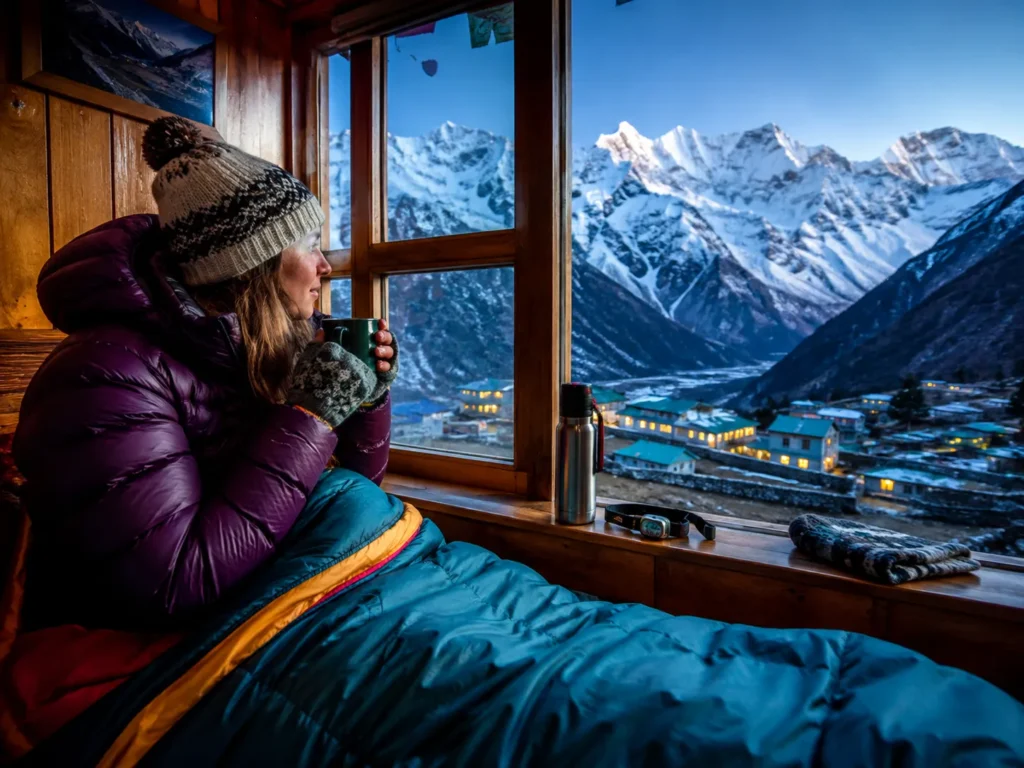
Cold nights are a normal part of the Langtang Valley Trek, especially as you climb toward higher elevations. Daytime temperatures can feel comfortable while walking, but conditions can become much colder after sunset.
The best way to stay comfortable is not simply to pack more clothes. You need to stay dry, use the right layers, carry a suitable sleeping bag, protect your hands and feet, and prepare your sleeping area before bed.
The Langtang region has cold conditions at higher elevations, and winter can bring snowfall. Nepal Tourism Board recommends spring and autumn as favorable trekking seasons for the region, while higher areas can remain cold outside these periods.
This guide explains exactly how to prepare for cold nights, what to wear, how to sleep comfortably in a teahouse, and when feeling cold could indicate a more serious problem.
Quick Overview: How to Stay Warm at Night
| Cold-Night Problem | What You Should Do |
| Cold sleeping room | Use a suitable sleeping bag and extra blankets if available |
| Cold hands and feet | Wear dry, warm socks and gloves |
| Sweaty trekking clothes | Change into completely dry clothes before sleeping |
| Cold air | Use a warm mid-layer and wind-resistant outer layer |
| Cold morning | Keep morning clothes beside your sleeping bag |
| Wet clothing | Dry it safely and keep it away from your sleeping clothes |
| Persistent shivering | Move somewhere warm and monitor for other symptoms |
| Confusion or extreme drowsiness | Treat it as a possible medical emergency |
Key point: The goal is to stay warm and dry without sweating. Moist clothing can increase heat loss in cold conditions.
Why Are Nights So Cold in Langtang Valley?
The Langtang Valley Trek takes you from lower areas into a high Himalayan environment. As elevation increases, temperatures generally become colder, and the difference between daytime and nighttime conditions can feel significant.
You may spend the afternoon walking under the sun and feeling comfortable in a light layer. After sunset, however, the temperature can drop quickly, particularly in higher villages.
Three factors make nights challenging:
1. Elevation
Higher parts of the trek have colder conditions than lower sections. Your sleeping system therefore needs to be suitable for the highest and coldest parts of your itinerary, not just the first few days.
2. Season
Winter brings the coldest conditions, and snowfall can occur at higher elevations. Spring and autumn generally offer more favorable trekking conditions, although nights can still be cold.
3. Lack of daytime activity
While walking, your body produces heat through physical activity. Once you stop walking and sit or sleep for several hours, you no longer have that same source of heat.
Simple example: A trekker may feel warm while walking to the Kyanjin area in the afternoon but become cold 30 minutes later while sitting inside a room. This does not mean the weather suddenly became dangerous. Their body simply stopped producing as much heat through movement.
What Should You Wear at Night?
The most effective approach is layering.
Instead of wearing one extremely thick jacket, use several layers that you can add or remove depending on how you feel.
A practical nighttime clothing system
| Layer | Purpose | Example |
| Base layer | Moves moisture away from skin | Thermal top and bottom |
| Mid-layer | Adds insulation | Fleece or warm sweater |
| Outer layer | Blocks wind and cold air | Insulated or wind-resistant jacket |
| Feet | Keeps toes warm | Thick, dry trekking or wool socks |
| Head | Reduces exposed skin | Warm hat or beanie |
| Hands | Protects fingers | Warm gloves or mittens |
The CDC recommends using multiple loose layers, moisture-managing clothing, insulation, and a wind-resistant outer layer in cold environments.
Important: Do not sleep in sweaty clothes
This is one of the easiest mistakes to avoid.
If your base layer is damp after several hours of trekking, change before going to bed.
Wet or damp clothing can increase heat loss and make you feel colder.
Short Tip: Keep one complete set of dry clothes specifically for sleeping. Do not use them for daytime trekking unless absolutely necessary.
How to Keep Your Sleeping Bag Warm
Your sleeping bag is one of the most important items for a cold night.
Choose a sleeping bag that is appropriate for:
- Your trekking season
- The elevation of the route
- Expected nighttime temperatures
- Your personal tolerance for cold
Do not judge a sleeping bag only by the word “winter” or “warm” on the product description. Check its temperature rating and understand whether the rating refers to a comfort, limit, or extreme temperature.
Before getting inside your sleeping bag:
- Change into dry sleeping clothes.
- Put on dry, warm socks.
- Organize your belongings.
- Keep your headlamp nearby.
- Place your morning clothes within reach.
- Use additional blankets if they are available and you need them.
Note: Do not put wet clothing inside your sleeping bag simply because you want it to dry. Damp fabric can make your sleeping environment uncomfortable and reduce warmth.
How to Keep Your Hands and Feet Warm
Cold hands and feet can make you feel uncomfortable even when the rest of your body is warm.
The first rule is simple:
Keep them dry.
Carry a separate pair of warm socks for sleeping. If your daytime socks become sweaty or wet, change into the dry pair before bed.
For your hands, use warm gloves or mittens when necessary. A warm hat can also help reduce heat loss from exposed areas.
The CDC recommends protecting the head, hands, feet, and other exposed skin when dealing with cold conditions.
Avoid making your footwear too tight.
Adding multiple pairs of thick socks inside a tight shoe can make your feet uncomfortable rather than warmer.
Your nighttime socks should fit comfortably without squeezing your feet.
Short Tip: Keep your sleeping socks inside your sleeping bag or another protected place so they remain dry and warm for the night.
What Should You Do Before Going to Bed?
A good bedtime routine can make a cold night much easier.
About 30-60 minutes before sleeping, prepare everything you may need so you do not have to repeatedly leave your warm sleeping bag.
Your simple bedtime routine:
Change: Put on completely dry sleeping clothes.
Eat: Have your evening meal so your body has energy.
Drink: Maintain normal hydration according to your needs.
Prepare: Arrange your headlamp, phone, water bottle, glasses, and other essentials.
Layer: Put on additional insulation if you are already feeling cold.
Ask: If you need another blanket, ask the teahouse staff before going to sleep.
Teahouses and lodges are common in the Langtang region, providing basic accommodation along trekking routes.
Best practice: Prepare for the night before you get very cold. It is easier to stay warm than to warm yourself after becoming deeply chilled.
What If You Wake Up Cold During the Night?
Do not panic. First, check the simple things.
Are your feet exposed?
Did you remove a layer?
Are your clothes damp?
Is your sleeping bag positioned properly?
If necessary, add a dry insulating layer or use an extra blanket.
But pay attention to persistent symptoms.
The CDC identifies continuous shivering, exhaustion, confusion, clumsiness, slurred speech, and unusual drowsiness as warning signs associated with hypothermia. Hypothermia is a medical emergency.
If someone develops these symptoms:
- Move them into a warm shelter.
- Remove wet clothing.
- Add dry insulation.
- Get medical assistance.
- Do not simply tell them to sleep.
Safety Note: Normal cold usually makes you uncomfortable and causes you to seek another layer. Confusion, poor coordination, unusual drowsiness, or worsening symptoms require much more serious attention.
Can Cold and Altitude Problems Happen Together?
Yes, but they are different problems.
Cold affects your body’s ability to maintain its temperature. Altitude illness is related to reduced oxygen availability as elevation increases.
The CDC explains that high-altitude environments combine cold, low humidity, increased ultraviolet exposure, and reduced air pressure. It also notes that oxygen-related stress can be greater during sleep.
Watch for symptoms such as:
- Headache
- Nausea
- Dizziness
- Unusual tiredness
- Difficulty sleeping
- Worsening symptoms after gaining elevation
Do not automatically assume these symptoms are caused by the cold.
If you feel unwell after ascending, tell your guide or trekking partner. The CDC recommends avoiding further ascent when experiencing symptoms of altitude illness and descending if symptoms become worse.
Important: Staying warm does not prevent altitude illness. Proper acclimatization and responding to symptoms are separate parts of high-altitude safety.
What Should You Pack for Cold Nights?
You do not need to pack an entire winter wardrobe. Focus on equipment that performs a specific job.
Cold-night essentials
| Item | Why It Matters |
| Suitable sleeping bag | Main source of nighttime insulation |
| Thermal base layers | Keeps skin dry and adds warmth |
| Fleece or insulating layer | Provides additional insulation |
| Warm jacket | Useful before bed and in the morning |
| Warm socks | Keeps feet comfortable |
| Gloves or mittens | Protects hands |
| Warm hat | Protects your head |
| Headlamp | Useful for nighttime movement |
| Dry sleep clothes | Prevents damp clothing from reducing warmth |
One smart packing strategy
Instead of packing five different sweaters, carry fewer useful layers that work together.
For example:
Thermal layer + fleece + insulated jacket
can give you more flexibility than one extremely bulky garment.
Cold-Night Mistakes to Avoid
Some mistakes are simple but can make a cold night much harder.
❌ Sleeping in sweaty trekking clothes
Why it is a problem: Moisture can increase heat loss.
Better approach: Change into dry sleep clothes.
❌ Packing only for daytime temperatures
Why it is a problem: Afternoon conditions can be much more comfortable than nighttime conditions.
Better approach: Prepare specifically for the coldest sleeping conditions on your itinerary.
❌ Waiting until you are freezing
Why it is a problem: It takes longer to warm yourself once you become deeply chilled.
Better approach: Add layers before you become very cold.
❌ Ignoring unusual symptoms
Why it is a problem: Serious cold-related illness or altitude illness can initially look like ordinary tiredness.
Better approach: Tell your guide or trekking partner when something feels unusually wrong.
People Also Ask About Cold Nights on the Langtang Trek
1. Are nights really cold on the Langtang Valley Trek?
Yes. Nighttime temperatures become colder as you gain elevation, and higher parts of the region can experience very cold conditions and snowfall during winter.
2. Do I need a sleeping bag for Langtang Valley?
A suitable sleeping bag is strongly recommended for cold nights. The warmth you need depends on the season, elevation, accommodation, and your personal tolerance for cold.
3. How do I stay warm in a Langtang teahouse?
Change into dry clothes, use a suitable sleeping bag, wear warm socks and a hat, add an insulating layer, and ask for additional blankets if needed.
4. What should I do if I keep shivering?
Persistent shivering should not be ignored. Move somewhere warm, remove wet clothing, add dry insulation, and monitor for symptoms such as confusion, clumsiness, slurred speech, or unusual drowsiness.
5. Is Langtang Valley cold in spring and autumn?
Nights can still be cold even during the more favorable trekking seasons. Higher elevations remain colder than lower villages, so proper nighttime layers and sleeping equipment are still important.
Key Takeaways
Before starting your Langtang Valley Trek, remember these points:
1. Prepare for nighttime, not just daytime.
Higher elevations can become very cold after sunset.
2. Stay dry.
Change sweaty or damp clothes before sleeping.
3. Use layers.
A base layer, insulating layer, and suitable outer layer give you better control over your body temperature.
4. Protect your extremities.
Warm socks, gloves, and a hat can make a major difference in comfort.
5. Use the right sleeping bag.
Choose one based on the season and expected conditions.
6. Prepare before bedtime.
Keep your headlamp, water bottle, clothes, and other essentials within reach.
7. Know the warning signs.
Confusion, unusual drowsiness, poor coordination, and persistent shivering require immediate attention.
8. Do not confuse cold with altitude illness.
They can occur together but require different responses.
Final Thoughts
Cold nights should not stop you from enjoying the Langtang Valley Trek. The key is to prepare for the conditions you will actually experience at higher elevations.
You do not need an excessive amount of equipment. You need the right equipment used correctly.
Keep your sleeping clothes dry. Use layers instead of relying on one heavy garment. Carry a suitable sleeping bag. Protect your hands, feet, and head. Prepare your sleeping space before bedtime. Most importantly, do not ignore symptoms that go beyond normal discomfort from cold.
If you are planning your trek and want help with the route, itinerary, accommodation, preparation, and trekking arrangements, Nepal Hiking Team can help you plan the Langtang Valley Trek according to your travel schedule and requirements.
You can review the Langtang Valley Trek itinerary and details here:
Langtang Valley Trek – Nepal Hiking Team >>> https://www.nepalhikingteam.com/package/langtang-valley-trek
For questions about your trek, you can also:
Contact Nepal Hiking Team >>> https://www.nepalhikingteam.com/contact-us
Or arrange your trip through:
Trip Booking – Nepal Hiking Team >>> https://www.nepalhikingteam.com/trip-booking
WhatsApp/Viber: +977 9851058678