
Many parents in the UK notice the same thing at some point. Maths homework suddenly takes forever. Your child gets upset over questions that used to feel easy. Or they say something like, “I’m just bad at maths.” When that happens, it may be a sign they need catch up maths support.
This is more common than people think. According to the UK Department for Education, about 27% of pupils did not reach the expected standard in Key Stage 2 maths in 2023. That means thousands of children across the UK are struggling with the basics before secondary school even begins.
Why Do Children Fall Behind in Maths?
Maths builds like a ladder. If one step is weak, climbing higher becomes harder.
Most children don’t suddenly fall behind overnight. It usually happens slowly. Maybe they miss a concept in Year 3 or Year 4. Then new topics build on that idea. Soon, the child is confused but doesn’t know why.
Common reasons include:
- missing a key topic in class
- weak times tables
- moving schools
- lack of practice
- losing confidence
I’ve noticed something else too. Many children understand maths during lessons, but they don’t practise enough afterwards. Without repetition, the knowledge fades.
And maths doesn’t forgive gaps very easily.
Parents often start looking for solutions at this point. Some turn to structured support, while others try simple routines at home using guides like Catch Up Maths Tips for Busy Families. The key is spotting the signs early and doing something about them before the gap gets bigger.
Let’s go through the warning signs parents usually notice first.
What Are the First Signs Your Child Is Struggling?
Children rarely say, “I don’t understand maths.”
Instead, you’ll notice behaviour changes.
Avoiding Maths Homework
This is often the first red flag.
You might hear things like:
- “I’ll do it later.”
- “This is too hard.”
- “Can we skip maths today?”
Sometimes parents think the child is being lazy. But in most cases, the child just feels stuck.
Avoiding work is often a way of avoiding embarrassment.
What usually works
Short, calm practice sessions help more than forcing long homework battles.
What often fails
Long lectures about “trying harder”. Those rarely solve the real problem.
Homework Suddenly Takes Much Longer
A worksheet that should take 15 minutes starts taking 45 minutes.
This usually means the child is struggling with the basic steps of solving the problem.
Example:
A pupil solving ¾ of 24 might still be working out 6 × 3.
So the main problem isn’t fractions. It’s multiplication.
That’s why maths gaps are tricky. The problem you see isn’t always the real one.
Does Your Child Struggle With Basic Number Facts?
Basic number facts are like the engine of maths.
Without them, everything runs slowly.
These include:
- times tables
- number bonds
- simple multiplication
- quick addition
Here’s a quick comparison.

I’ll be honest here. In my opinion, times tables are still one of the biggest barriers for many pupils. If those aren’t automatic, maths becomes tiring.
What usually works
Daily 5-minute practice. Short and frequent.
What often fails
Huge worksheets once a week. Children usually lose focus halfway through.
Why Do Word Problems Feel So Hard?
Ask most pupils what they dislike about maths.
They’ll probably say word problems.
These questions combine reading and maths. That’s where confusion starts.
Example:
A shop sells pencils in packs of 6. Tom buys 4 packs. How many pencils does he have?
Some pupils do 6 + 4.
Not because they don’t know multiplication. They just panic when they see words.
A simple trick that helps
Tell children to ask three questions:
- What is happening in the story?
- What numbers matter?
- What operation makes sense?
Breaking the problem into steps makes it less scary.
What Happens When Maths Confidence Drops?
Confidence changes everything.
Once a child believes they’re “bad at maths”, progress slows down.
You’ll notice things like:
- giving up quickly
- refusing to answer in class
- saying “I can’t do this”
Education researcher Jo Boaler explains this clearly:
“Mistakes are valuable because they show where learning can grow.”
But many pupils see mistakes as proof they’re failing.
Helping them realise mistakes are normal is part of the solution.
Why the Spiral Curriculum Actually Helps
One teaching method that works well in maths is the spiral curriculum.
The idea came from psychologist Jerome Bruner.
Instead of teaching a topic once and forgetting it, pupils return to it later.
Each time, the topic becomes slightly harder.
Here’s a simple example.
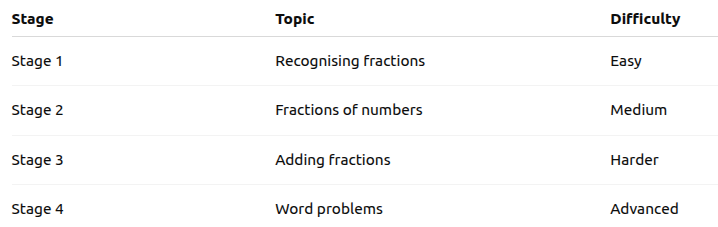
This approach helps knowledge stick.
The Smashmaths catch-up maths programme follows a spiral learning structure. Topics reappear regularly so pupils strengthen old skills while learning new ones.
Personally, I think this works far better than the “teach it once and move on” method.
Kids forget things. Revisiting topics makes sense.
What Usually Works When Helping Children Catch Up
Over the years, certain strategies have consistently helped children improve.
1. Short Daily Practice
15–20 minutes a day is enough.
Long study sessions usually lead to frustration.
2. Revisiting Old Topics
Children often need to revisit earlier topics.
This isn’t going backwards. It’s fixing the foundation.
3. Building Confidence First
Sometimes, improving confidence matters more than solving harder questions.
When children feel capable, they try more.
What Often Fails (and Wastes Time)
Not every approach helps.
Some things sound useful but rarely work well in practice.
1. Huge Homework Sessions
Three hours of maths rarely helps anyone.
Children get tired and stop thinking clearly.
2. Random Worksheets
Without structure, worksheets can repeat topics a child already understands.
3. Waiting Too Long
Many parents hope the problem will fix itself.
Sometimes it does. But often the gap just grows.
A Simple Routine That Helps Most Children
If you want to help your child catch up, keep things simple.
Here’s a routine that works for many families.
Step 1 — Warm up (5 minutes)
Practice times tables or number bonds.
Step 2 — Practice questions (10 minutes)
Focus on one topic at a time.
Step 3 — Talk about mistakes (5 minutes)
Ask what felt confusing.
This conversation is important. It helps children understand their thinking.
Catch Up Maths Support vs No Support
Here’s a simple comparison.
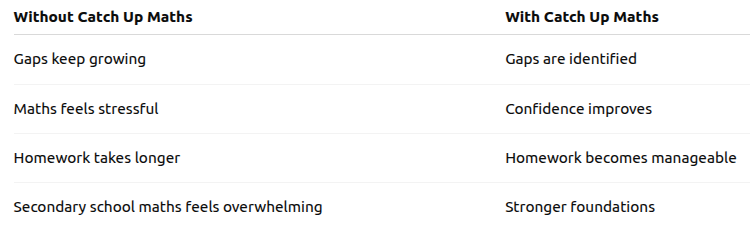
The difference often comes down to consistent support.
Final Thoughts
Maths struggles are incredibly common. They don’t mean a child isn’t capable.
Most of the time, the issue is simply missing pieces of knowledge.
The encouraging part is that those gaps can be fixed.
Spotting the early signs — homework struggles, weak number facts, or low confidence — gives parents a chance to step in before things get worse.
The Smashmaths approach focuses on rebuilding foundations through structured catch-up maths support and spiral learning. Instead of rushing forward, it strengthens the basics so children can move ahead with confidence.
In my experience, the biggest change happens when children realise maths isn’t impossible — they just need the right help at the right time.
Key Takeaways
- Maths gaps often start small but grow over time
- Avoiding homework can signal a deeper problem
- Weak number facts slow down everything else
- Confidence plays a huge role in maths success
- Structured catch-up maths support helps rebuild foundations