
Anyone who has worked with linear LED lighting knows this problem.
You install a clean aluminium profile, switch on the lights, and suddenly those harsh LED dots ruin the entire look. This is exactly where a milky diffuser makes the difference between average lighting and a professional finish.
If you are sourcing a white LED diffuser in India, the choice is not just about colour. It is about light quality, durability, fitment, and long-term performance. Based on real installation experience, here are the most important factors you should consider before buying one.
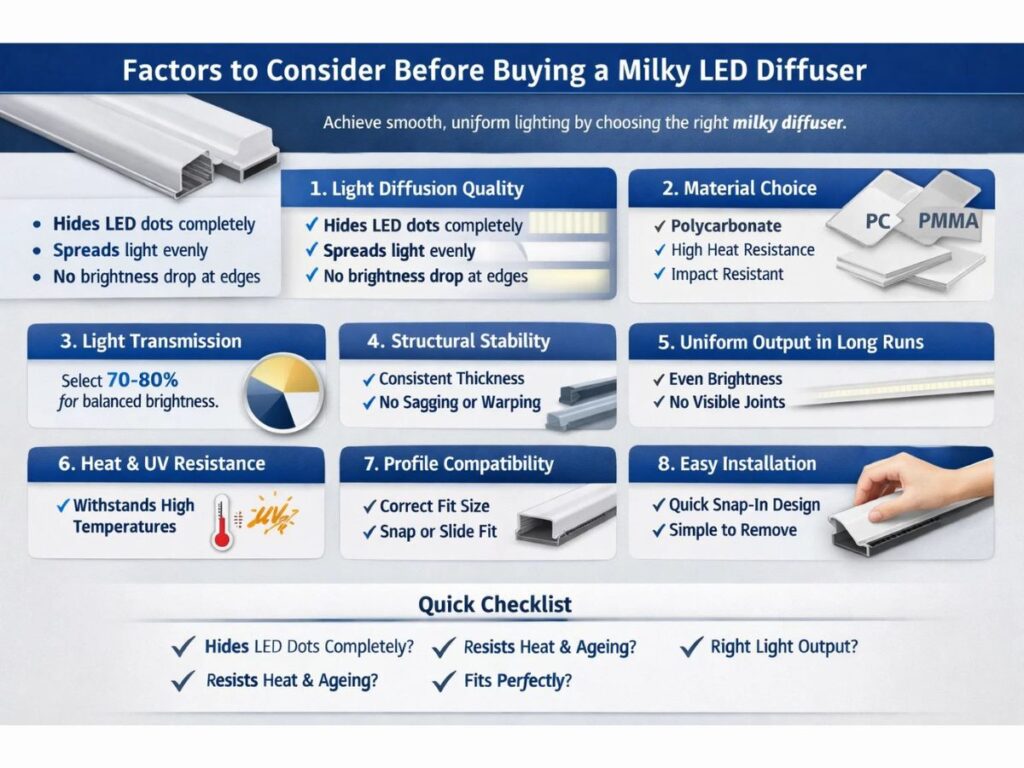
What Is a Milky LED Diffuser and Why It Matters
A milky LED diffuser is a translucent cover, usually made from polycarbonate or acrylic, designed to soften LED light. It spreads the light evenly, reduces glare, and hides individual LED points.
In practical terms, it helps you achieve:
- Smooth, continuous lighting
- Better visual comfort
- A cleaner, more premium appearance
For commercial, retail, and architectural projects, a good white LED diffuser in India is not optional. It is essential.
1. Light Diffusion Quality Comes First
Not all milky diffusers diffuse light the same way. Some only blur LED dots, while others create a truly uniform glow.
When evaluating diffusion quality, check:
- How well LED hotspots are concealed
- Whether light spreads evenly across the full length
- If brightness drops sharply at the edges
A high-quality milky diffuser should balance diffusion and brightness. Too opaque and you lose light output. Too transparent, and LED points remain visible.
2. Material Choice: Polycarbonate vs Acrylic
Material directly affects lifespan and performance.
Polycarbonate Diffusers
- High impact resistance
- Better heat tolerance
- Suitable for long-run industrial and commercial use
Acrylic Diffusers
- Better optical clarity
- Less impact resistant
- More suitable for decorative or low-heat applications
For demanding installations, polycarbonate milky diffusers are usually the safer option when selecting a white LED diffuser in India.
3. Light Transmission Percentage
This is a factor many buyers overlook.
Light transmission typically ranges between 60% and 85%.
Lower transmission means softer light but reduced brightness.
As a practical guideline:
- Retail and offices usually work well with 70–80% transmission
- Decorative lighting can go lower for a softer effect
- Task lighting may need higher transmission
Always match the diffuser to the LED wattage and application.
4. Thickness and Structural Stability
Thin diffusers may look fine initially but can sag or deform over time, especially in longer LED profiles.
Look for:
- Consistent thickness across the profile
- Resistance to bending during installation
- Stable fit without rattling or popping out
This becomes especially important in ceiling-mounted linear lighting systems.
5. Achieving Consistent Output in Linear LED Fixtures
One of the main reasons professionals choose a milky diffuser is to achieve consistent output in linear LED fixtures.
In long runs, even small variations in diffusion become noticeable. A well-designed milky diffuser:
- Maintains uniform brightness from start to end
- Minimises visible joins between LED strips
- Keeps lighting visually consistent across large spaces
This is critical in offices, retail aisles, corridors, and architectural lighting where uneven light immediately stands out.
6. Heat Resistance and Long-Term Performance
LEDs generate heat, and poor-quality diffusers can yellow, crack, or warp over time.
Before buying, confirm:
- Operating temperature range
- UV resistance for sun-exposed areas
- Ageing performance over years, not months
A reliable white LED diffuser in India should maintain colour stability even with continuous usage.
7. Compatibility With LED Profiles
Diffusers are not one-size-fits-all.
Check:
- Profile width and depth compatibility
- Snap-fit or slide-fit mechanism
- Ease of removal for maintenance
Incorrect fitment leads to gaps, light leakage, and installation delays.
8. Ease of Installation and Maintenance
From real site experience, this matters more than brochures suggest.
Good diffusers:
- Snap in smoothly without tools
- Stay secure during vibration or cleaning
- Can be removed without damaging the profile
This saves time during installation and future servicing.
9. Customisation and Supply Consistency
For large projects, consistency matters as much as quality.
If you are sourcing diffusers in bulk, ensure:
- Uniform colour across batches
- Dimensional accuracy every time
- Availability for repeat orders
This is where working with an experienced manufacturer like M3 Extrusion helps, especially for projects requiring consistent profiles and finishes.
Quick Buying Checklist
Before finalising your milky diffuser, ask these questions:
- Does it fully hide LED dots at my chosen spacing?
- Is the light output suitable for the application?
- Will it resist heat and ageing over time?
- Does it fit securely into my LED profile?
If the answer is yes to all four, you are on the right track.
FAQs
What is the difference between a milky diffuser and a clear diffuser?
A milky diffuser spreads light evenly and hides LED points, while a clear diffuser allows more brightness but shows individual LEDs. Milky diffusers are preferred for visual comfort and professional lighting finishes, especially in commercial and architectural applications.
Does a milky diffuser reduce LED brightness significantly?
Yes, a milky diffuser reduces brightness slightly, depending on its light transmission level. However, this loss is intentional and helps create uniform lighting. Choosing the right transmission percentage ensures a balance between softness and adequate illumination.
Which material is better for a white LED diffuser in India?
Polycarbonate is generally better for Indian conditions due to its heat resistance, impact strength, and durability. Acrylic offers better clarity but is more suitable for low-heat, decorative applications where impact resistance is less critical.
Can milky diffusers be used for long linear LED installations?
Yes, milky diffusers are ideal for long linear LED fixtures. They help maintain consistent output, reduce visible LED joints, and create smooth continuous lighting across extended lengths without visual breaks.
Do milky diffusers turn yellow over time?
Low-quality diffusers may yellow due to heat and UV exposure. High-quality polycarbonate milky diffusers are designed to resist discolouration and maintain colour stability even with long-term continuous use.
How do I choose the right thickness for a milky diffuser?
Thicker diffusers offer better structural stability and diffusion, especially for wider profiles. The ideal thickness depends on profile size and application, but it should remain rigid without sagging over long spans.
Are milky diffusers suitable for both commercial and residential lighting?
Yes, milky diffusers work well in both settings. They provide glare-free, uniform lighting for offices and retail spaces while also creating soft, comfortable illumination in residential linear lighting designs.



люстры в интерьере деревянная люстра
мужской костюм ткани мужской костюм интернет магазин