Hiring the right employee is not just about skills and interviews. One wrong hire can lead to financial loss, workplace conflict, data theft, or even legal trouble.
For businesses and employers in Atlanta and across Georgia, background checks are not optional anymore. These are basic steps to protect your company, your staff, and your customers.
This blog answers how to check an employee’s background the right way, what really matters, what is legally allowed, and when working with a Private Investigator in Atlanta makes sense. Everything is explained in simple terms so anyone can understand and apply it correctly.
Why are Employee Background Checks Important
Hiring decisions today carry more risk than most employers realize. Employees often have access to customer data, company finances, inventory, and internal systems. A background check helps you confirm that what a candidate says matches reality.
In Georgia, many cases of workplace fraud, theft, and harassment could have been avoided with proper screening. A resume can hide job gaps, fake degrees, or false job titles. Interviews show personality, not history.
A background check helps you:
- Reduce hiring risks
- Protect company assets
- Maintain a safe work environment
- Avoid negligent hiring lawsuits
- Build trust within your team
For Atlanta businesses that operate in regulated industries like healthcare, finance, childcare, security, or transportation, background screening is often required by law.
Understanding What a Background Check Really Includes
Many employers think a background check only means a criminal record search. That is not true. A proper background check includes multiple layers, each serving a specific purpose.
Core Parts of an Employee Background Check
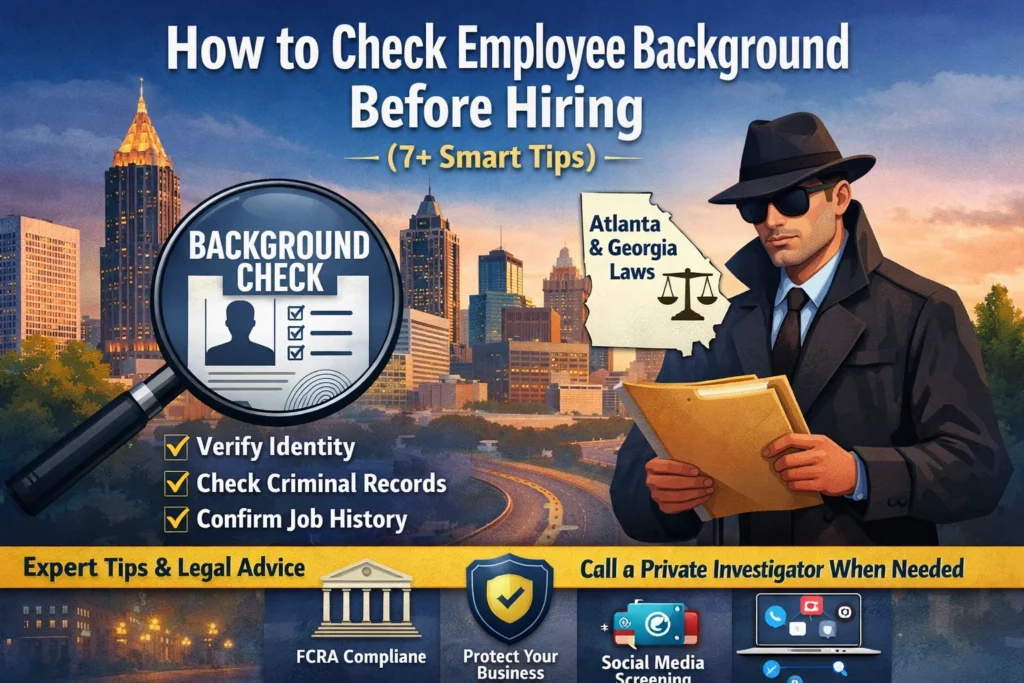
- Identity verification
- Employment history
- Education verification
- Criminal history
- Credit history when job-related
- Reference checks
- Social media review when legally allowed
Each part must be handled carefully and legally, especially under federal laws like the Fair Credit Reporting Act and Georgia employment laws.
Tip 1: Always Verify Identity First
Before checking anything else, confirm the candidate is who they claim to be.
Why is Identity Verification Important
If identity is wrong, all other checks become useless. Identity verification helps detect:
- Fake names
- Incorrect Social Security numbers
- Use of another person’s identity
What to Check
- Government-issued photo ID
- Social Security number trace
- Address history consistency
An SSN trace does not show criminal records but helps confirm name and address history. This step also guides where criminal records should be searched.
For Atlanta employers, identity checks are especially important due to a high number of interstate job applicants.
Tip 2: Check Criminal Records the Right Way
Criminal history is one of the most sensitive parts of background checks. It must be accurate, relevant, and legally compliant.
What Criminal Records Tell You
Criminal records can show:
- Felony convictions
- Misdemeanor convictions
- Pending cases
- Arrest records were legally allowed
What Employers Often Get Wrong
- Relying on cheap online databases
- Ignoring county-level searches
- Rejecting candidates automatically without context
In Georgia, employers must also be mindful of the First Offender Act. If a candidate’s record has been sealed under this act, it generally cannot be used as a basis for disqualification
Georgia law allows employers to consider criminal history, but it must relate to the job. A theft conviction matters for finance roles. It may not matter for unrelated positions.
A Private Investigator in Atlanta often conducts deeper criminal checks using county courts instead of unreliable national databases.
Tip 3: Confirm Employment History with Real Proof
Many applicants exaggerate job titles, responsibilities, or employment dates.
What to Verify
- Company names and locations
- Job titles
- Employment dates
- Reason for leaving when available
Red Flags to Watch For
- Overlapping job dates
- Inflated titles
- Employers that cannot be contacted
- Fake companies or closed businesses
Employment verification protects you from hiring someone who lacks the experience required for the role.
In Georgia, false job history is one of the most common issues found during professional background checks.
Tip 4: Verify Education and Professional Licenses
Degrees and certifications can be misrepresented with ease on resumes. Verification is critical for skilled roles.
Education Verification Includes
- High school diploma
- College degree
- Trade school certification
- Professional licenses
Why This Matters in Atlanta
Atlanta has strong industries in healthcare, logistics, construction, and finance. Many roles require valid licenses issued by Georgia boards. Hiring someone without a valid license can result in fines, lawsuits, or loss of business licenses.
Always verify directly with educational institutions or licensing authorities.
Tip 5: Check References with Purpose, Not Formality
Many employers treat reference checks as a formality. That is a mistake.
How to Conduct Effective Reference Checks
Ask specific, job-related questions:
- What were their main responsibilities?
- How did they handle pressure?
- Were there any attendance issues?
- Would you rehire them?
Avoid vague questions that lead to generic answers.
Legal Considerations
References may avoid negative comments due to legal risks. Listen carefully to tone, hesitation, and what is not said.
Professional investigators know how to ask compliant but revealing questions without crossing legal boundaries.
Tip 6: Use Credit Checks Only When Job-Relevant
Credit checks should never be used for every position.
When Credit Checks Make Sense
- Financial management roles
- Accounting positions
- Access to company funds
- Executive roles
Georgia and Federal Compliance
Under the Fair Credit Reporting Act:
- You must get written consent
- You must notify the candidate if credit affects hiring
- You must provide a copy of the report if adverse action is taken
A credit report does not show income or spending habits. It shows financial responsibility patterns.
Tip 7: Review Social Media Carefully and Legally
Social media screening can expose employers to legal and discrimination risks if not handled correctly. Viewing a candidate’s online presence may reveal protected information such as age, religion, disability, or political views. Once seen, this information cannot be “unseen,” which can create compliance issues if a hiring decision is later challenged.
Best Practices for Social Media Screening
- Review only publicly available content
- Never request passwords or access private accounts
- Avoid evaluating protected characteristics or personal beliefs
- Focus strictly on job-related behavioral red flags
What Can Be Considered
- Public threats of violence
- Evidence of illegal activity
- Harassment, hate speech, or conduct that could pose workplace safety risks
Recommended Approach
To reduce risk, have a third party or a non-decision maker perform the social media review. This person should filter out protected characteristics and report only relevant, work-related concerns. Decision-makers should receive a neutral summary focused on behavior—not personal traits.
Improper social media screening is a growing cause of employment lawsuits. A cautious, structured approach helps protect both the employer and the candidate while maintaining a fair hiring process.
Tip 8: Understand Consent and Legal Compliance
Background checks without consent can create serious legal trouble.
Required Steps Before Screening
- Standalone Disclosure: You must provide a clear, written disclosure to the candidate in a document that consists solely of the disclosure.
- Written Authorization: Obtain a signed consent form before running any reports.
- Georgia & FCRA Alignment: Ensure your process follows both federal and Georgia-specific privacy and “Fair Chance” guidelines.
After the Background Check
If you choose not to proceed with hiring based on the report:
- Pre-Adverse Action Notice: If the report is a reason for rejection, notify the candidate first.
- Provide Copies: Give them a copy of the report and a “Summary of Your Rights under the FCRA.”
- The Waiting Period: Allow the candidate 5 business days to dispute inaccuracies.
- Final Adverse Action Notice: Only after the waiting period should you send the final rejection notice.
Skipping these steps can result in fines and lawsuits.
Tip 9: When to Hire a Private Investigator in Atlanta
Not all background checks are equal. Some situations require deeper investigation.
Situations Where an Investigator Helps
- Executive or leadership hires
- Internal promotions with high access
- Suspicious resume inconsistencies
- Sensitive roles involving security or finances
- Due diligence for business partners
A licensed Private Investigator in Atlanta has access to lawful databases, field verification methods, and investigative techniques that standard background check services cannot offer.
They also understand Georgia-specific laws and court systems, which improves accuracy and compliance.
Common Background Check Mistakes Employers Make
Rushing the Process
Fast hiring often leads to overlooked details. One missed red flag can cost more than a delayed hire.
Using Cheap Online Reports
Low-cost reports often contain outdated or incorrect data. Wrong information can lead to wrongful rejection or negligent hiring claims.
Ignoring Job Relevance
Not every negative finding matters. Context is everything.
Failing to Document Decisions
Always document why a background finding was relevant to the job role.
People Also Ask – Employee Background Checks Explained
1. How long does an employee background check take in Georgia?
Most standard background checks take 2 to 5 business days. Complex cases involving multiple counties or education verification may take longer.
2. Can an employer run a background check without permission?
No. Written consent is required under federal law. Running a check without permission can lead to legal penalties.
3. Do background checks show all criminal records?
No. Some records may be sealed, expunged, or outside the search scope. County-level searches provide the most accurate results.
4. How far back do background checks go in Georgia?
Criminal conviction history often goes back seven years or more, depending on job type and legal guidelines.
5. Can a background check be wrong?
Yes. Errors happen due to name matches, outdated databases, or reporting mistakes. That is why candidates must be given a chance to dispute findings.
Key Takeaways
- Background checks protect businesses, employees, and customers
- Identity verification is the foundation of all checks
- Criminal history must be job-related and legally reviewed
- Employment and education verification prevent false hiring
- Consent and compliance are not optional
- Social media checks must stay professional and legal
- A Private Investigator in Atlanta provides deeper, lawful insights for sensitive hires
Our Final Thoughts!
Hiring without proper background checks is a risk no Atlanta or Georgia employer should take. A careful, legal, and well-structured screening process helps you hire with confidence and avoid costly mistakes. If you are hiring for a role that involves trust, access, or responsibility, do not rely on guesswork or cheap online tools.
Start by reviewing your current hiring process. Identify gaps in identity checks, employment verification, or compliance steps. For sensitive or senior-level roles, consider hiring a licensed Private Investigator in Atlanta who knows Georgia laws and can legally uncover critical facts.
The goal is not to reject candidates. The goal is to hire the right people with clear information and full confidence. That is how you build a safe, reliable, and successful workplace.
Written by: Capital One Consulting
Capital One Consulting is a private investigation and security company based in Atlanta, Georgia. We help people and businesses find the truth, stay safe, and solve legal or personal issues through investigation and protection services.
Also Read:
10 Types of Evidence a Court Never Accepts from PIs in Atlanta
Is It Legal for Private Investigators to Track Your Phone?
How Private Investigators Help in Child Custody Disputes