
The first few weeks with a newborn feel like a blur—feeding, diaper changes, crying, sleeping… and repeat. Most parents don’t even know what day it is. But here’s something surprising: according to the American Academy of Pediatrics (AAP), newborns need structured feeding and sleep tracking to support healthy growth and development. That’s exactly why many parents today rely on a newborn daily routine tracking app to stay organized. If you want a simple tool that actually helps, you can check this here:
What Does Tracking Your Baby’s Routine Actually Mean?
Let’s keep it simple.
Tracking your baby’s routine means noting down:
- Feeding times
- Sleep patterns
- Diaper changes
- Growth milestones
It’s like keeping a daily diary for your baby—but smarter and easier with an app.
Instead of guessing, you know what your baby needs.
Why Do Most Parents Struggle in the First Few Weeks?
Is it just a lack of experience?
Not really. It’s an overload.
New parents (especially in India) often:
- Get very little sleep
- Receive too much advice from family
- Try to remember everything mentally
And honestly, memory doesn’t work well when you’re exhausted.
What usually goes wrong?
- Forgetting the last feeding time
- Confusion between day and night routines
- Inconsistent sleep schedules
- Stress over “Am I doing this right?”
I’ve seen this again and again—parents aren’t careless, they’re just overwhelmed.
How Does a Tracking App Make Life Easier?
A good tracking app works like a second brain.
It:
- Records everything automatically
- Shows patterns you can’t see
- Gives reminders when needed
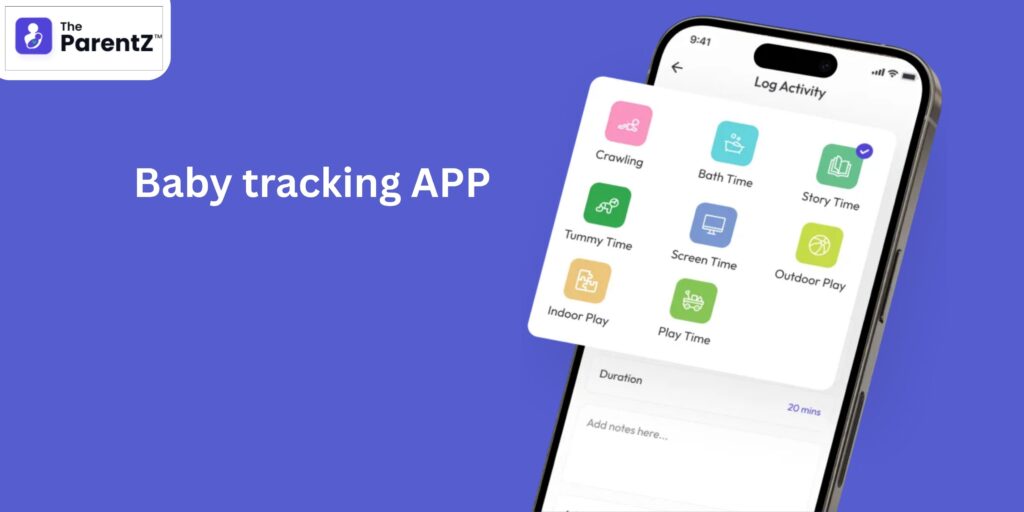
Apps like The Parentz are designed for this exact purpose—simple tracking without making things complicated.
Benefits of Tracking Your Baby’s Routine
1. You Stop Guessing and Start Understanding Your Baby
How does tracking help you “read” your baby?
At first, every cry sounds the same.
But when you track:
- You notice feeding intervals
- You see sleep patterns
- You understand triggers
It’s like solving a puzzle. Slowly, things start making sense.
What works: Consistent tracking
What fails: Trying to remember everything in your head
2. Feeding Becomes More Predictable
Why is feeding timing so confusing?
Because newborns don’t follow a clock.
Some feed every 2 hours, some cluster feed.
Tracking helps you:
- Know the last feeding time
- Avoid underfeeding or overfeeding
- Build a loose routine
Example: If your baby is fed at 2 PM, you won’t panic at 3 PM thinking they’re hungry again.
3. Sleep Patterns Start to Improve
Can tracking really fix sleep?
Not instantly—but it helps a lot.
When you track sleep:
- You see, when your baby is naturally sleepy
- You avoid overtiredness
- You slowly build a routine
Think of it like learning your baby’s “sleep language.”
4. You Reduce Stress (More Than You Expect)
Does this actually make parents feel better?
Yes. And this is underrated.
When everything is written down:
- You stop second-guessing
- You feel more in control
- You worry less
My honest take: This is one of the biggest benefits. Less mental chaos = better parenting.
5. Doctor Visits Become Easier and More Useful
What do doctors usually ask?
- How often is the baby fed?
- How many wet diapers?
- How is sleep?
Most parents guess. That’s normal.
But with tracking, you give exact answers. That helps doctors guide you better.
6. Helps Identify Early Health Issues
Can tracking really catch problems early?
Yes, sometimes.
For example:
- Fewer wet diapers → possible dehydration
- Sudden sleep changes → discomfort or illness
- Feeding drop → something might be off
Tracking doesn’t replace a doctor—but it gives early clues.
7. Makes It Easier for Multiple Caregivers
What if grandparents or a nanny are involved?
Very common in Indian homes.
Without tracking:
- Everyone does things differently
- Confusion builds up
With an app:
- Everyone follows the same log
- No repeated feeding
- No missed changes
What works: Shared access
What fails: Verbal updates like “I think I fed him.”
8. Builds a Healthy Routine From the Start
Do routines really matter this early?
Not strict routines—but gentle patterns.
Tracking helps you:
- Create consistency
- Build habits
- Set a foundation for future routines
It’s like planting seeds early. You don’t see results immediately, but they grow over time.
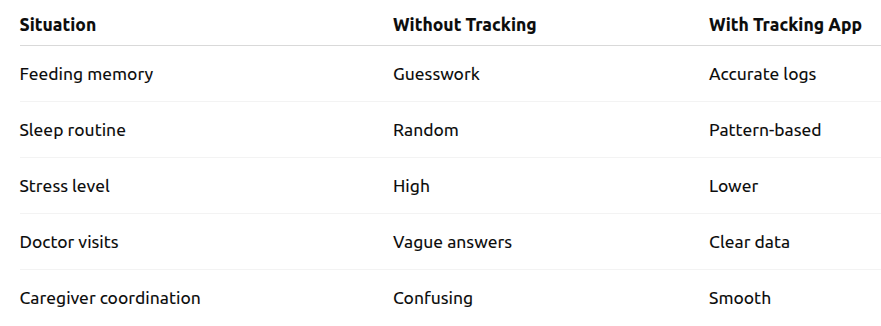
Comparison Table: With vs Without Tracking
Step-by-Step: How to Track Your Baby’s Routine
Step 1: Start with the basics
Track feeding, sleep, and diapers first.
Step 2: Keep It Simple
Don’t try to track everything at once.
Step 3: Use an App
Manual tracking gets tiring. Apps make it easier.
Step 4: Be Consistent (Not Perfect)
Missing one entry is fine. Just continue.
Step 5: Review Patterns Weekly
Look for trends, not daily perfection.
Real-Life Example
A new mom in Bangalore managing:
- Night feedings
- Household work
- Advice from elders
Without tracking → confusion, stress, lack of sleep
With tracking → clarity, better routine, more confidence
This is very real. I’ve seen parents relax once they start tracking.
What Usually Works (From Experience)
✔ What works:
- Simple apps with a clean design
- Quick logging (few taps)
- Clear summaries of patterns
✖ What fails:
- Overcomplicated tracking systems
- Trying to log every tiny detail
- Apps that feel like extra work
One Personal Judgment
If tracking feels like a burden, you’re doing too much.
Keep it simple. Only track what actually helps you.
Parents don’t need perfection—they need clarity.
Pro Tips for Parents
- Track feeds and sleep first (most important)
- Don’t compare your baby’s routine with others
- Use reminders if needed
- Share access with your partner
- Review patterns every few days
FAQs
1. Do I need to track from day one?
Not mandatory, but very helpful. Starting early makes things easier.
2. Is it okay if I miss some entries?
Yes. Consistency matters more than perfection.
3. Can I track without an app?
You can, but apps save time and reduce effort.
4. Will this make my baby follow a strict schedule?
No. It helps you understand patterns, not force routines.
5. Is it useful for breastfeeding moms?
Very useful. Helps track feeding frequency and duration.
Conclusion
Here’s the truth—newborn life is unpredictable. No app or system will make it perfect.
But tracking your baby’s routine gives you something very important: clarity.
You stop guessing. You start understanding.
A newborn daily routine tracking app isn’t about control—it’s about support. And tools like The Parentz do a good job of keeping things simple without overwhelming you.
And honestly, in those sleep-deprived early days, simple is exactly what parents need.
Key Takeaways
- Tracking helps you understand your baby better
- Reduces stress and mental overload
- Improves feeding and sleep patterns
- Helps during doctor visits
- Works best when kept simple