
Table of Contents
Travel agents across the United States and Canada are facing a clear shift in how travel is planned and sold. Travelers now expect fast responses, personalized itineraries, and real-time updates when things change.
At the same time, agents are expected to manage more clients without increasing their workload.
AI travel planning tools help bridge this gap. They reduce manual work, improve accuracy, and make it easier to deliver tailored travel experiences at scale.
This guide breaks down the real benefits of these tools, with practical explanations that show how they fit into a travel agent’s daily workflow.
Why AI Travel Planning Tools Are Becoming Essential for Travel Agents
Travel planning is no longer just about booking flights and hotels. A typical client now expects a complete experience – including local activities, timing suggestions, backup plans, and even dining recommendations.
This shift has created a workload problem.
Without AI tools, agents often spend hours:
- Researching destinations
- Comparing options
- Building itineraries manually
The challenge is not just time. It is consistency. When agents are under pressure, the quality of planning can vary.
AI tools solve this by creating a structured system for planning. Instead of starting from scratch every time, agents work with a smart foundation that already includes relevant data, timing, and suggestions.
This allows agents to focus more on refining the experience rather than building it from scratch. Over time, this shift improves both efficiency and service quality.
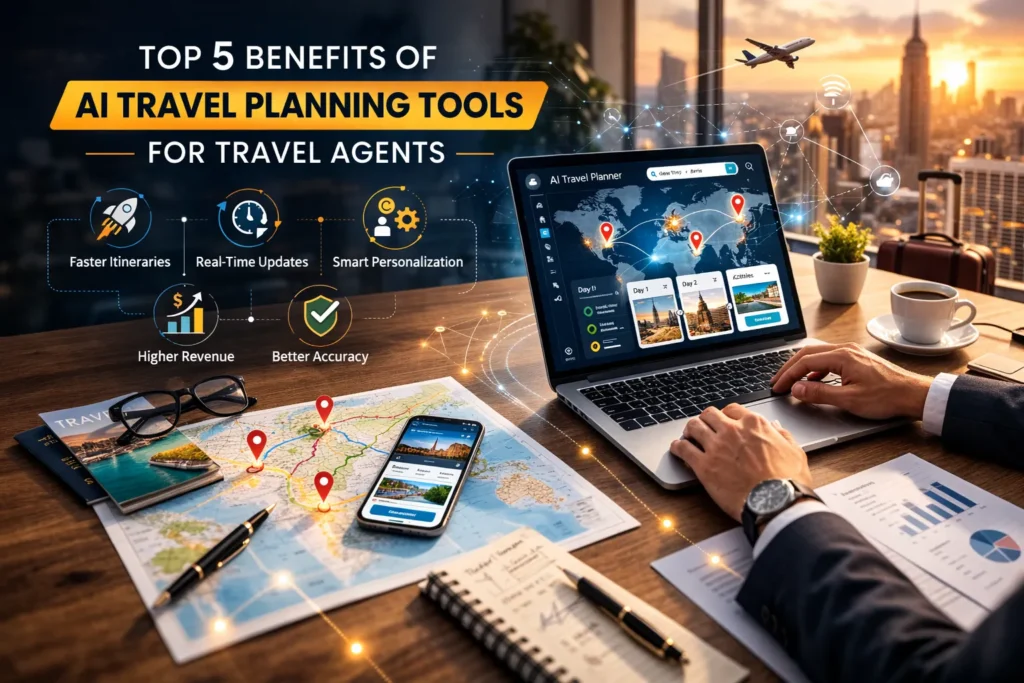
Top 5 Benefits of AI Travel Planning Tools for Travel Agents
1. Faster Itinerary Creation Without Compromising Quality
Speed is one of the biggest challenges in travel planning. Clients expect quick responses, often within hours. But creating a detailed itinerary manually can take much longer.
AI tools change how this process works.
Instead of gathering information piece by piece, the agent inputs key details such as travel dates, budget, and interests. The system then generates a structured itinerary that includes destinations, activities, and timing.
What makes this valuable is not just speed, but structure.
The itinerary is already organized in a logical flow. For example:
- Activities are grouped by location
- Travel time between places is considered
- The schedule feels realistic, not rushed
This gives agents a strong starting point.
From there, the agent can adjust details based on their expertise. This combination of automation and human input ensures that quality is not lost.
In practical terms, this means an agent who previously handled 3-4 clients per day can now handle significantly more without sacrificing service quality.
2. Real-Time Adjustments That Keep Travel Plans Reliable
Travel plans rarely go exactly as expected. Weather changes, flights get delayed, and attractions may close without notice.
Traditionally, handling these changes required constant monitoring. Agents had to stay updated and manually adjust plans when something went wrong.
AI tools introduce a different approach.
They continuously track real-time data such as:
- Weather conditions
- Opening hours
- Local disruptions
When something changes, the itinerary is updated automatically.
This is important because timing matters. If a change is handled too late, it affects the entire day’s schedule.
For example, if an outdoor activity becomes unavailable due to weather, the tool can instantly replace it with a suitable indoor option. This prevents gaps in the itinerary and keeps the experience smooth for the traveler.
From a business perspective, this reduces stress for the agent and improves reliability for the client. Over time, this builds trust, which is critical for repeat bookings.
3. Higher Accuracy That Reduces Costly Mistakes
Accuracy is a major concern in travel planning. Even small mistakes can lead to poor experiences.
Common issues include:
- Incorrect opening hours
- Overlapping activities
- Unrealistic travel times
These mistakes often happen because information is collected from multiple sources, and not all of them are updated regularly.
AI tools address this by working with verified and continuously updated data sources.
Instead of relying on manual checks, the system ensures that:
- Locations are open at the planned time
- Travel durations are realistic
- Activities do not conflict with each other
This creates a more reliable itinerary.
For travel agents, this has a direct impact on operations. Fewer mistakes mean fewer complaints, fewer last-minute fixes, and less time spent correcting issues.
It also strengthens the agent’s reputation. Clients are more likely to trust and recommend an agent who consistently delivers smooth, well-planned trips.
4. Scalable Personalization Without Increasing Workload
Personalization is no longer optional. Travelers expect their trips to match their preferences, whether it is food, pace, or type of activities.
The challenge is that personalization takes time.
Without AI, agents must manually tailor each itinerary based on client input. This limits how many clients they can serve effectively.
AI tools solve this by analyzing preferences and applying them automatically.
For example, if a traveler prefers:
- Cultural experiences
- Relaxed schedules
- Local dining
The system builds an itinerary that reflects those choices.
What makes this powerful is scalability.
The agent does not need to repeat the same effort for every client. The system handles the base customization, while the agent fine-tunes the details.
This allows agents to offer a high level of personalization to many clients simultaneously.
From a business perspective, this improves client satisfaction and increases the chances of repeat business.
5. More Revenue Opportunities Through Smarter Recommendations
Many travel agents focus primarily on major bookings, such as flights and hotels. While these are important, they are not the only sources of revenue.
Activities, experiences, and add-ons often provide additional income opportunities.
The challenge is identifying what to offer.
AI tools analyze traveler preferences and suggest relevant add-ons within the itinerary. These suggestions are not random. They are based on what fits naturally into the travel plan.
For example, a traveler visiting a coastal destination might receive suggestions for:
- Water activities
- Local tours
- Dining experiences
Because these options are integrated into the itinerary, they feel like part of the plan rather than an extra sale.
This increases the likelihood that clients will accept these recommendations.
For agents, this means higher revenue per booking without needing to increase the number of clients.
How Simplified.Travel Helps Travel Agents Apply These Benefits
Understanding the benefits is one thing. Applying them in daily work is another.
Simplified.Travel is designed to make this transition easier.
It works directly within a travel business’s website, allowing agents to create and manage itineraries without switching between multiple tools.
What makes it practical is how its features align with real tasks.
For example, its itinerary engine builds structured travel plans using verified data. If something changes, the system updates the plan automatically. It also supports bookings within the itinerary, which helps agents manage everything in one place.
Another important aspect is branding. Since the tool is white-labeled, clients experience it as part of the agent’s website, not a separate platform or tool.
This helps maintain trust and consistency.
In real-world use, this means agents can:
- Build itineraries faster
- Adjust plans without manual effort
- Offer a smoother client experience
Experience Simplified.Travel Today:
What Real Problems AI Travel Tools Solve for Travel Agents
It is important to look beyond features and focus on problems.
The biggest issue agents face is time. Manual planning takes too long, especially when dealing with multiple clients.
The second issue is inconsistency. Different clients may receive different levels of service depending on workload.
The third issue is missed opportunities. Without structured recommendations, agents may not offer additional services that clients would actually value.
AI tools address all three problems at once. They reduce time spent on routine tasks, create a consistent planning process, and surface relevant opportunities for upselling.
This combination makes them more than just a convenience. They become a core part of efficient operations.
Are AI Travel Planning Tools Difficult to Use in Daily Work?
Many agents hesitate to adopt new tools because they expect a steep learning curve.
In reality, most modern AI tools are designed to be simple.
They typically require:
- Basic inputs
- Minimal setup
- No technical background
The interface is often structured in a way that mirrors the natural planning process. This makes it easier for agents to adapt.
Within a short time, the tool becomes part of the daily workflow rather than an extra step.
Do AI Tools Replace the Role of Travel Agents?
This is a common concern, but it is based on a misunderstanding.
AI tools handle tasks that are repetitive and data-heavy. They do not replace human judgment, creativity, or relationship-building.
Travel agents still play a key role in:
- Understanding client needs
- Making complex decisions
- Providing reassurance and support
AI simply removes the time-consuming parts of the process.
In practice, this makes agents more effective, not less relevant.
What Travel Agents Should Do Next!
The travel industry is moving toward faster and more personalized services. Clients expect smooth planning and quick adjustments when things change.
Trying to meet these expectations manually is becoming difficult.
AI travel planning tools offer a practical way forward. They support daily tasks, reduce pressure, and improve the overall quality of service.
The next step is not to fully change your workflow overnight. Start by testing a tool with a few clients. Observe how much time it saves and how clients respond to the experience.
If the results are positive, expand its use gradually.
Travel agents who adopt these tools early will be better positioned to handle future demands. Not because they rely on technology, but because they use it to deliver better service in a more efficient way.
Written by: Simplified.Travel (AI-Powered Travel Itinerary Builder Software for Tourism Businesses)
Also Read:
5+ Daily Tour Operator Challenges Solved by AI Itinerary Builder
How White Label Itinerary Builders Save Time for Travel Agencies